Mitacs Funding Offers

What is Mitacs?
Mitacs is a not-for-profit organization whose mission is to prepare the next generation for the Canadian knowledge and innovation economy. It is funded by the federal and provincial governments. Mitacs works with partners in the private, public, and academic sectors to support collaborative research projects.
Mitacs Fundings
Who are the fundings for?
All full-time or part-time students enrolled in a professional or research program at master’s or PhD level are eligible for Mitacs fundings, as are postdoctoral researchers. International scholars are eligible but must obtain the necessary work or study permit.
What are the fundings for?
Mitacs fundings are for students to carry out research or innovation projects in partnership with sectors outside of academia.
A recipient of a Mitacs funding is known as an “intern”, as the project takes the form of an internship in which the individual collaborates with a professor offering academic supervision, as well as a non-academic partner. The internship must involve either in-person interactions at the partner organization's facilities or remote participation. This allows the intern to bring their academic knowledge to a non-academic environment and acquire new skills which will serve them as they integrate into the world of work following their studies. The internship may or may not be part of their academic progress. This decision must be made in consultation with the academic supervisor.
How much money is available?
There are various Mitacs fundings - described below - to meet the different objectives the partner, the intern, and the professor may have. The funding given to the intern varies by program but starts at $6,000.
How long does the internship last?
The duration of the internship depends on the research or innovation project, and on the academic level of the intern. One internship lasts four or six months. Award recipients can carry out multiple internships;
- The only limit at the graduate level: A postdoctoral researcher may complete up to 9 internship credits.
See examples of previous Mitacs internships in your discipline: Projects | Mitacs
Mitacs Funding Programs
| Programs* | Program Objectives | Internship duration and Total funding amount | Master's degrees | Ph.D. | Post-doctorate | ||||||||
Deadline: Rolling (apply anytime) | Contribute to your partner organization’s research and development/bring your academic skills to the world of work. |
|
|
|
| ||||||||
Deadline: Rolling (apply anytime) | Fund your company’s research and development. Student-entrepreneurs can self-finance to contribute to their company’s research and development. The company must be housed within a Mitacs-approved incubator. |
|
|
|
| ||||||||
(For now, this is reserved to students in the Faculty of Arts and Sciences) Deadline: Rolling (apply anytime) | Help a partner organization develop and analyze its service or product offering. |
|
|
| n/a | ||||||||
In collaboration with UdeM international Limited funding | Carry out a research project at a university abroad or at Université de Montréal. |
|
|
| n/a |
*Most of our programs are also open to undergraduate students.
**Subject to change based on the eligibility criteria established by UdeM International and the funding allocated each year.
Who is eligible to be a partner organization?
- Incorporated companies in Canada
- Certain non-profit organizations (NPOs) registered in Canada.
- Incorporated foundations in Canada
- Municipalities or municipal organizations
- Hospitals
Who chooses the partner organization?
The person receiving a funding must identify a partner organization for themselves. However, it is often the case that the academic supervisor already has a partnership in place for which they wish to recruit interns. We therefore advise you to discuss your intention to carry out a Mitacs internship with your academic supervisor so they can help you find a partner organization.
How to find a partner organization?
Solution 1: Consult the pool of open projects currently available on the Mitacs website: Open projects.
Solution 2: Find a partner yourself. Contact an organization representative:
- Explain the advantages of accepting you as an intern: academic expertise, low internship cost, a potential future employee
- Inform yourself about the deliverables that would be demanded of you (a report, a consultation, a pamphlet, etc.)
- Ask about the organization’s financial contribution - they must pay part of the funding. The partner organization’s financial contribution is generally 50% (for example, $7,500 out of $15,000), but sometimes a reduced amount is offered temporarily (for example, $3,750 out of $15,000). It is also possible for multiple partner organizations to contribute to the funding.
More information is available here: FAQ | Mitacs
What are the responsibilities and obligations involved in a Mitacs project?
The obligations of all involved parties can be found here: Project responsibilities | Mitacs
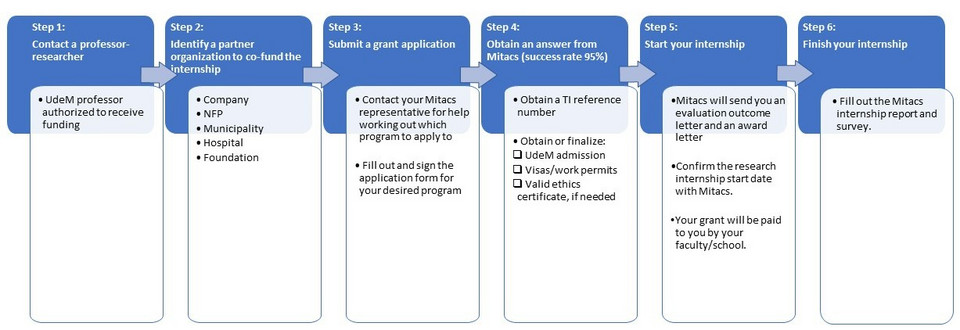
Process for obtaining a Mitacs funding
Business Development Advisor, Mitacs
Visou Ady : vady@mitacs.ca
Billel Djerir, PhD
- Department of Computer Science and Operations Research (DIRO)